QuikBooze
A multi-store SaaS control plane for provisioning and managing independent WordPress and WooCommerce storefronts.
PROJECT VISUALS / 01
Visual explorer
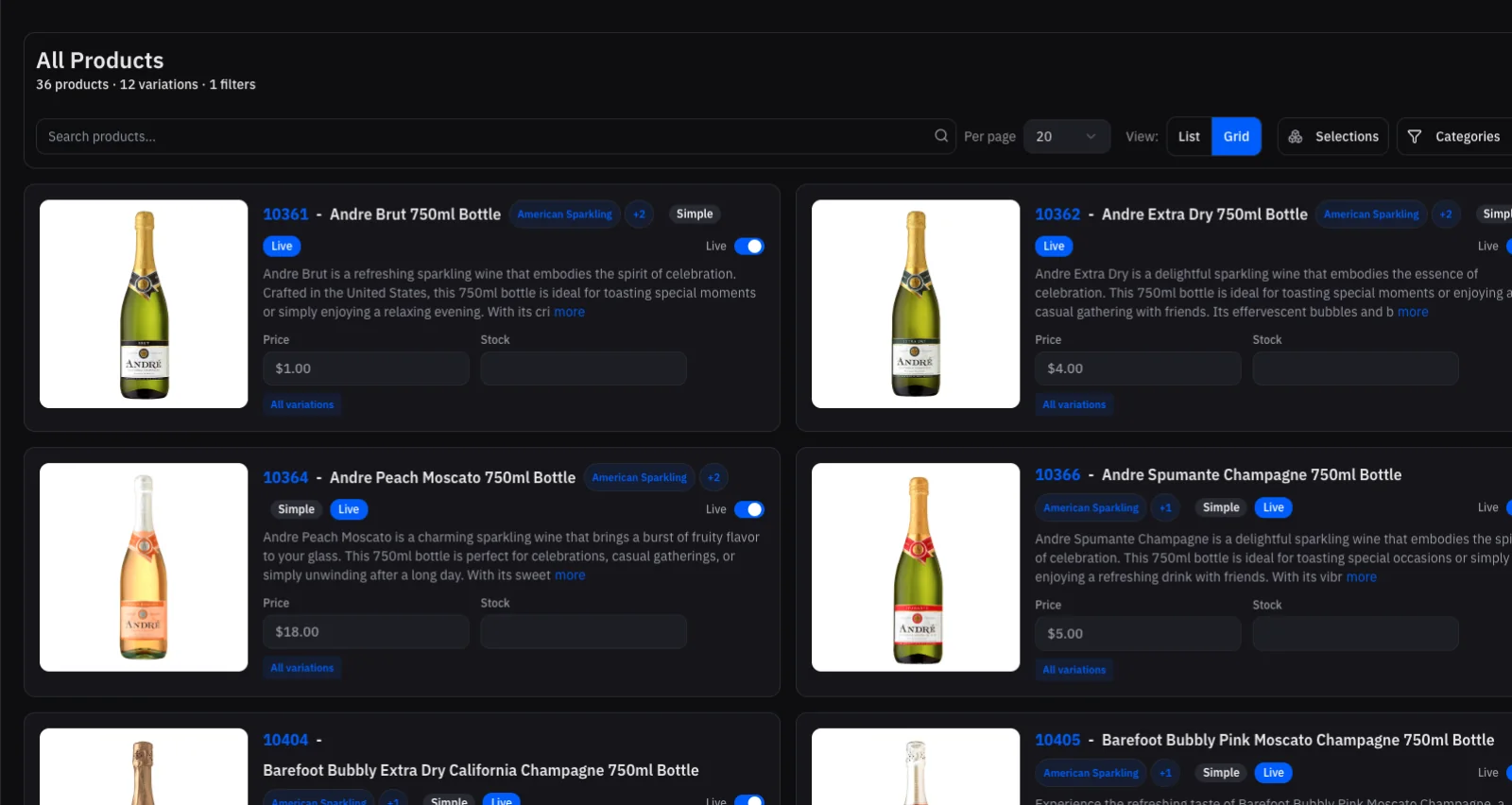
Scroll or swipe thumbnails to browse
01 / OVERVIEW
Project overview
QuikBooze brings store administration, catalog workflows, and provisioning into a centralized application while each merchant storefront runs as an independent WordPress and WooCommerce installation. I designed and developed the application and its WordPress integration architecture.
02 / PROJECT SNAPSHOT
At a glance
- Project type
- Client project
- Category
- SaaS · Node.js · TypeScript · Product Development · API Integrations · WordPress · WooCommerce · Custom Plugin Development · Frontend Development · Backend Development
- Status
- In development
03 / ROLE & CONTRIBUTION
My role
I designed and developed the application and its WordPress/WooCommerce integration architecture.
- Built the centralized SaaS control plane with the Next.js App Router, React, TypeScript, and Tailwind CSS.
- Designed authentication and account-security workflows using NextAuth.js, Google OAuth, credentials authentication, JWT sessions, and TOTP-based two-factor authentication.
- Implemented a job-based store-provisioning workflow that coordinates independent WordPress/WooCommerce installations.
- Designed product-selection and catalog-loading workflows across a central catalog and store-specific product state.
- Built the application-to-store integration architecture using custom WordPress REST routes and server-side API communication.
- Developed Clover catalog and inventory synchronization workflows and guarded payment-setup orchestration for merchant stores.
- Kept experimental delivery work separate from the merchant storefront and payment lifecycle.
04 / CUSTOM PLUGIN DEVELOPMENT
Custom plugin development
Standalone WordPress extensions documented from the available project source.
QuikBooze Clover Bridge
A WordPress-side REST bridge for controlled Clover and WooCommerce catalog synchronization.
Workflows
- Exposes routes for health checks, WooCommerce product and category snapshots, product metadata linking, price and inventory updates, and reviewed draft product or category creation.
- Supports QuikBooze-managed catalog and per-store synchronization workflows.
Implementation
- Runs in the store's WordPress environment and uses WooCommerce product and category APIs.
- Keeps store-side writes behind a bridge boundary instead of asking browser code to call WordPress directly.
Integrations
- WordPress REST API and WooCommerce.
- Clover synchronization coordinated by the QuikBooze application.
Interface evidence gap: No approved, credential-free screenshot of the WordPress-side Clover bridge itself is available yet.
QuikBooze Uber Direct Bridge (experimental)
An experimental, store-specific foundation for future delivery quote workflows.
Workflows
- Holds checkout-mode and session-quote groundwork for a future controlled delivery flow.
- Separates readiness and preview work from provider execution.
Implementation
- Optional WordPress companion bridge, separate from the central SaaS application.
- Current project documentation classifies this bridge as experimental and support-only; it is not the active manager delivery path.
- Live provider calls, checkout wiring, and delivery dispatch are not enabled in the documented implementation.
Integrations
- WooCommerce integration groundwork.
- Uber Direct is a planned provider boundary; no live dispatch is claimed.
Interface evidence gap: This is a development-stage integration, not a live delivery feature.
05 / TECHNOLOGIES
Technology stack
- Next.js App Router
- React
- TypeScript
- Tailwind CSS
- Node.js
- MySQL
- Prisma
- NextAuth.js
- WordPress REST API
- WooCommerce
- PHP
- PM2
- Linux
- OpenLiteSpeed
- Stripe
- Clover
- Uber Direct (experimental)
06 / PROJECT NOTES
Approach & implementation
The challenge
Managing a portfolio of independent WooCommerce stores creates a coordination problem: store setup, catalog preparation, store-specific product choices, and operational state need one place to manage, while each storefront still needs its own WordPress installation and commerce data. QuikBooze addresses that problem with a centralized control plane connected to separate store runtimes.
System architecture
The implementation is organized around several cooperating parts:
- SaaS control plane: A Next.js App Router application provides the manager interface and authenticated application routes.
- Control-plane data: Prisma and MySQL store account, store, catalog-workspace, provisioning, billing, and integration state.
- Provisioning worker: A Node.js and TypeScript worker claims queued work and hands store creation to the documented server-side provisioning boundary.
- Independent store runtimes: Provisioning documentation describes a separate WordPress/WooCommerce installation, database, Linux user, document root, and store-specific configuration for each store.
- Store integration: The application communicates server-to-server through custom WordPress REST routes and WooCommerce-aware bridge code.
The local project includes a PM2 process configuration and documents Linux/OpenLiteSpeed provisioning. This case study does not expose hostnames, account identifiers, or internal server paths.
Store and catalog workflows
The product-management design separates the master catalog from each store’s product workspace. A product can be not added, prepared for a store, or selected for the live storefront. Store-specific overrides are kept distinct from the canonical catalog snapshot. Provisioning and synchronization use that selection state to prepare WooCommerce products without treating every store as one shared catalog.
The application source includes product and catalog API routes, a WordPress bridge client, and store-provisioning job routes. The architecture keeps browser-facing manager workflows in the SaaS application and WordPress communication on the server side.
Authentication and account security
The application uses NextAuth.js v4 with the Prisma adapter and JWT sessions. The documented account flows include Google OAuth and credentials authentication, alongside account verification and recovery workflows. The project security design also documents TOTP-based two-factor authentication and recovery codes.
These are implementation details from the local application and its security documentation, not a claim of an independent security audit or certification.
Payments, POS, and delivery
Stripe
QuikBooze has platform-billing code and manager workflows for configuring a merchant’s WooCommerce Stripe payment plugin. The application can stage and synchronize merchant payment settings through its worker; the actual storefront checkout gateway is a separate WooCommerce plugin. This case study does not claim a verified live merchant charge or production payment configuration.
Clover
The Clover work includes an application-side synchronization workflow and a WordPress bridge for product/category snapshots and approved catalog updates. Source and project documentation show the integration architecture; this review did not make live Clover requests or verify a current merchant sync.
Uber Direct
Delivery setup, readiness, and preview/shadow work exists in the project. The QuikBooze-owned Uber Direct bridge remains experimental. Current project documentation keeps provider calls, live checkout wiring, and delivery dispatch disabled, so this case study does not present Uber delivery as a live feature.
Realtime and infrastructure boundary
Provisioning documentation describes publishing an event as a job progresses, and the local project contains a realtime server source file. The exact transport and deployment topology were not established for this case study. Redis, WebSocket, and Server-Sent Events are therefore not listed as implemented technologies.
My role
I designed and developed the QuikBooze application and its WordPress/WooCommerce integration architecture. My work spans the manager application, catalog and store workflows, authentication architecture, provisioning coordination, and the custom API/bridge boundary between the control plane and independent stores.
Project status and visual evidence
The gallery includes five supplied application-interface captures, fourteen marketing-site captures, and eight workflow-explainer graphics. Marketing and explainer visuals are labelled separately from application captures. These images document interfaces and product communication; they do not verify current service availability, merchant outcomes, live payments, or third-party API operation.
QuikBooze remains in development. The application, database schema, provisioning worker, WordPress API integration, and Clover bridge source are present locally. Integration behavior is not uniform: merchant Stripe checkout depends on the separate WooCommerce gateway being configured, and the QuikBooze-owned Uber Direct path remains experimental without live provider calls or dispatch. No current production deployment, uptime, customer count, or business outcome is claimed here.